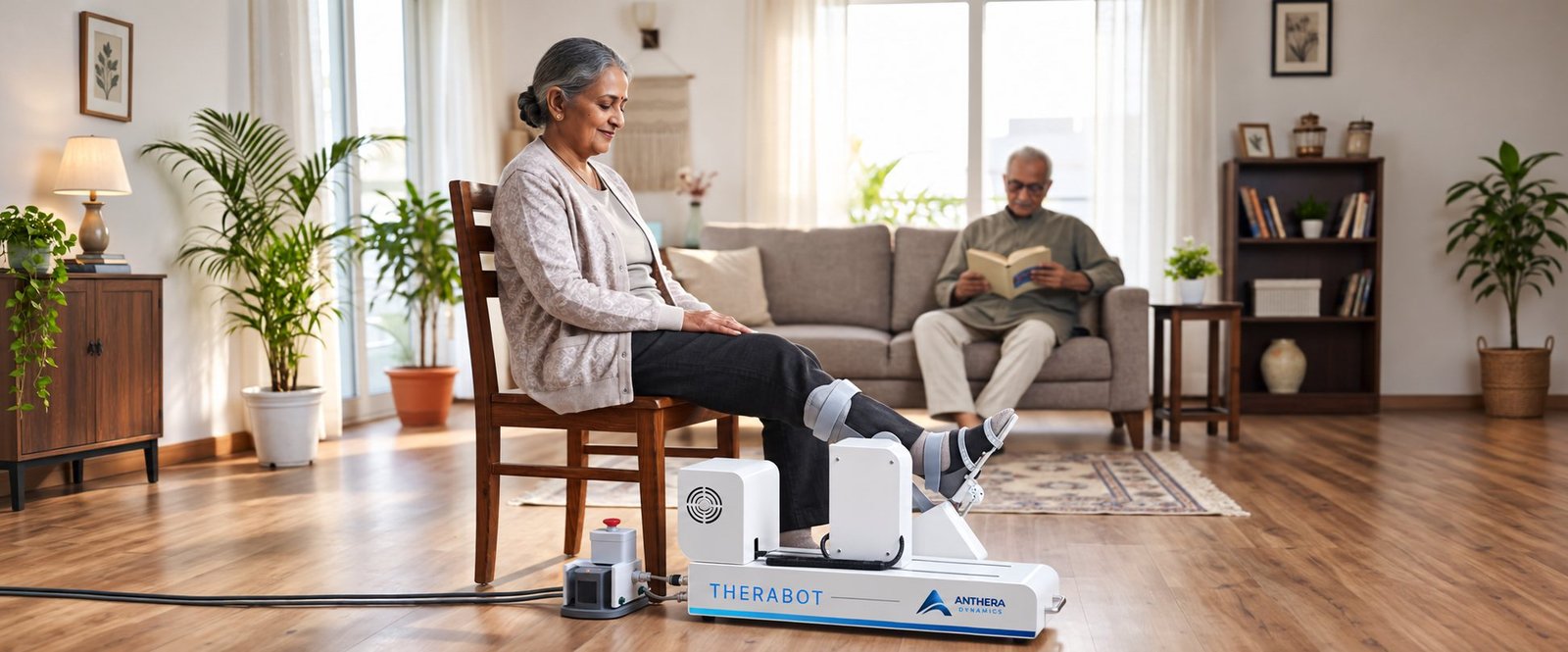
For many people after a stroke, one question matters more than any other: will I walk again on my own? Rehabilitation research has been asking whether robots can help answer "yes" for more than two decades, and the largest reviews now give a consistent picture.
The headline result
The 2020 Cochrane review of electromechanical and robot-assisted gait training pooled 62 trials with 2,440 participants. Adding these devices to physiotherapy increased the odds of becoming independent in walking (odds ratio 2.01, 95% CI 1.51 to 2.69, from 38 trials with 1,567 people).1
Put in everyday numbers: of 100 people who could not walk independently, about 45 would do so after physiotherapy alone, compared with about 62 when electromechanical gait training was added.1 The 2025 update of the review, with more trials included, again found higher odds of independent walking (odds ratio 1.65, 95% CI 1.21 to 2.25).2
Why it works: steps, not minutes
Observational research found that stroke therapy sessions average around 357 steps,3 while motor-learning research suggests that thousands of repetitions a day may be needed to drive lasting change. Gait robots let patients practise many more steps, with support and a consistent pattern, than would be safe or possible by hand. In the trials reviewed by Cochrane, sessions typically lasted 30 to 60 minutes, three to five days a week, for three to four weeks.4
The device does not walk for the patient. It lets the patient practise walking far more than they otherwise could.
Beyond stroke
The pattern extends to other neurological conditions. A meta-analysis of seven randomised trials in Parkinson's disease found robot-assisted gait training improved stride length by about 9.3 cm and Berg Balance Scale scores by about 3.9 points, with balance gains still present a month later.5
The barrier has been access
Most gait robots in these trials are large, fixed installations costing hundreds of thousands of dollars, which is why they are concentrated in a small number of specialist centres. Making gait training portable and affordable, so it can happen on the ward, in the local clinic and at home, is the step that brings these results to the patients who need them.
This article summarises published research on robotic and electromechanical gait training in general. It is not about Anthera products specifically, which are currently sold as assistive devices and are not medical devices. It is not medical advice.
References
- Mehrholz J, et al. Electromechanical-assisted training for walking after stroke. Cochrane Database Syst Rev. 2020;10:CD006185. doi:10.1002/14651858.CD006185.pub5
- Mehrholz J, et al. Electromechanical-assisted training for walking after stroke (update). Cochrane Database Syst Rev. 2025;5:CD006185. doi:10.1002/14651858.CD006185.pub6
- Lang CE, et al. Observation of amounts of movement practice provided during stroke rehabilitation. Arch Phys Med Rehabil. 2009;90(10):1692–1698. doi:10.1016/j.apmr.2009.04.005
- PEDro. Systematic review found that electromechanical- or robot-assisted training increases the likelihood of independent walking after stroke. pedro.org.au
- Alwardat M, et al. Effectiveness of robot-assisted gait training on motor impairments in people with Parkinson's disease. Int J Rehabil Res. 2018;41(4):287–296. doi:10.1097/MRR.0000000000000312