Ask a neuroscientist how the brain relearns a movement after stroke and the answer will involve one word again and again: practice. Not a little practice. A lot of it. In laboratory studies of motor learning, animals perform 400 to 600 repetitions of a reaching task in a single session.1
So how much practice do people actually get in rehabilitation?
Counting what really happens
In 2009, a team led by Catherine Lang observed 312 physical and occupational therapy sessions for people with stroke across seven inpatient and outpatient sites. They counted every repetition. Task-specific arm practice happened in only 51% of the sessions that addressed the arm, and averaged 32 repetitions. Gait sessions averaged 357 steps.1
The gap is not about therapist commitment. Guiding a weak arm through hundreds of movements, patient after patient, is physically demanding and limited by the hours in a day.
Raising the dose is possible
When the same research group designed one-hour outpatient sessions around high repetition, people with chronic stroke averaged 322 repetitions per session, attended 97% of their sessions and reported low pain and fatigue.2 Dose, it turns out, is something a programme can choose.
At larger scale, the Queen Square Upper Limb programme in London delivers 90 hours of therapy over three weeks. Among 224 patients, who were a median of 18 months past their stroke, median Fugl-Meyer arm scores rose from 26 at admission to 37 six months after the programme, and Action Research Arm Test scores from 18 to 27. Gains continued to grow after discharge.3
Chronic stroke is not a plateau to accept. With enough practice, people keep improving long after the textbook window has closed.
Where robots come in
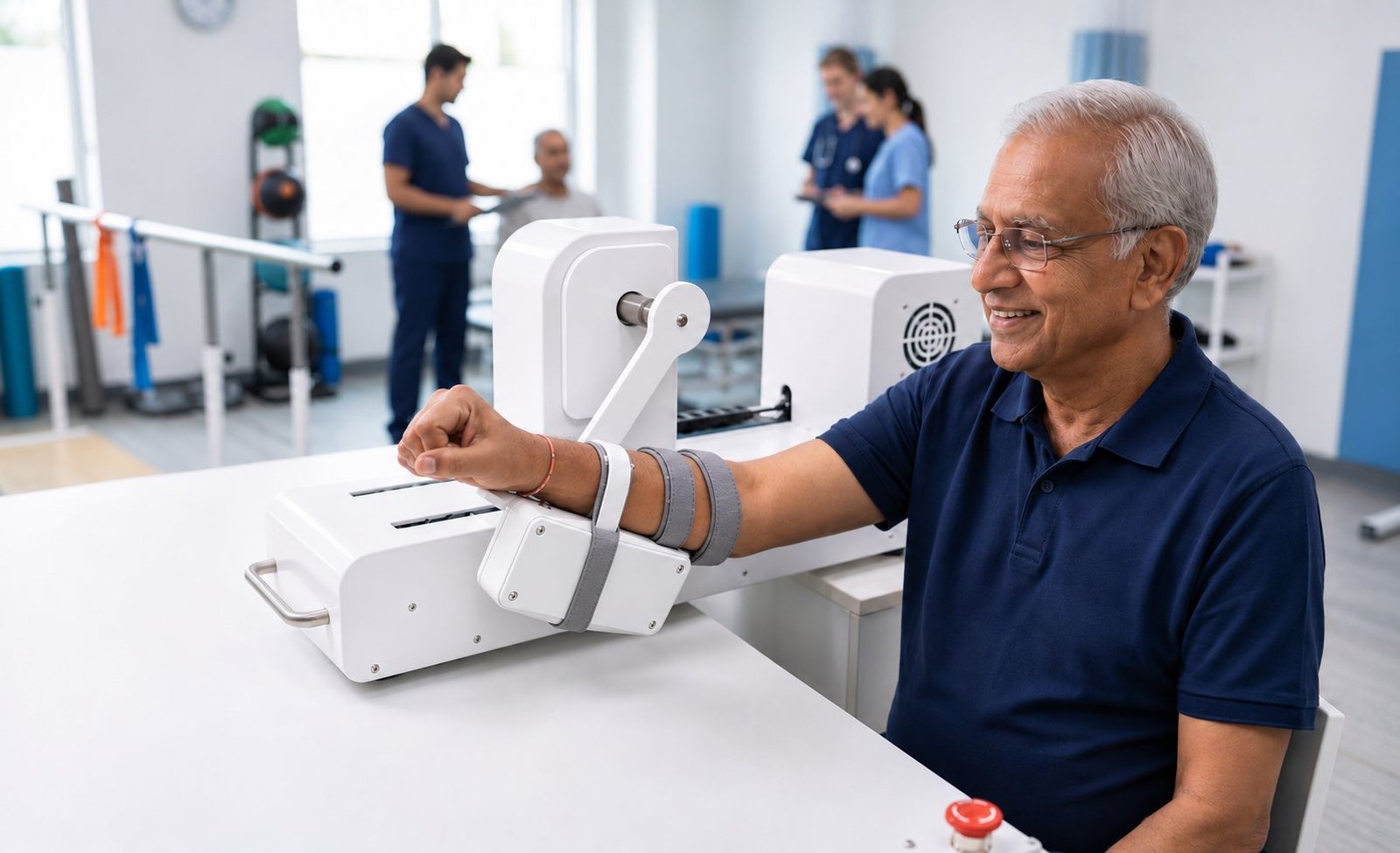
Robots are very good at exactly the part of rehabilitation that wears humans out: precise, repeated, guided movement. In the VA ROBOTICS trial, published in the New England Journal of Medicine, each one-hour robotic session delivered 1,024 arm movements. Veterans at least six months after stroke improved their Stroke Impact Scale scores by 7.64 points over usual care at 12 weeks, and their Fugl-Meyer scores by 2.88 points at 36 weeks.4
Across the wider literature, a Cochrane review of 45 trials and 1,619 participants concluded that electromechanical and robot-assisted arm training improves activities of daily living, arm function and arm muscle strength after stroke, rating the evidence as high quality. Adverse events were rare.5
The takeaway for care teams
The research does not say robots replace therapists. It says that the amount of practice matters, and that most patients get far less than they need. Technology that lets one therapist deliver a high dose to several patients, and lets patients keep practising at home, is one of the most direct ways to close that gap.
This article summarises published research on robotic and high-intensity rehabilitation in general. It is not about Anthera products specifically, which are currently sold as assistive devices and are not medical devices. It is not medical advice.
References
- Lang CE, et al. Observation of amounts of movement practice provided during stroke rehabilitation. Arch Phys Med Rehabil. 2009;90(10):1692–1698. PMC3008558
- Birkenmeier RL, Prager EM, Lang CE. Translating animal doses of task-specific training to people with chronic stroke in 1-hour therapy sessions. Neurorehabil Neural Repair. 2010. PMC3235711
- Ward NS, Brander F, Kelly K. Intensive upper limb neurorehabilitation in chronic stroke: outcomes from the Queen Square programme. J Neurol Neurosurg Psychiatry. 2019;90(5):498–506. doi:10.1136/jnnp-2018-319954
- Lo AC, et al. Robot-assisted therapy for long-term upper-limb impairment after stroke. N Engl J Med. 2010;362(19):1772–1783. PMC5592692
- Mehrholz J, et al. Electromechanical and robot-assisted arm training after stroke. Cochrane Database Syst Rev. 2018;9:CD006876. cochrane.org/CD006876