45 trials
Better daily living, arm function and strength
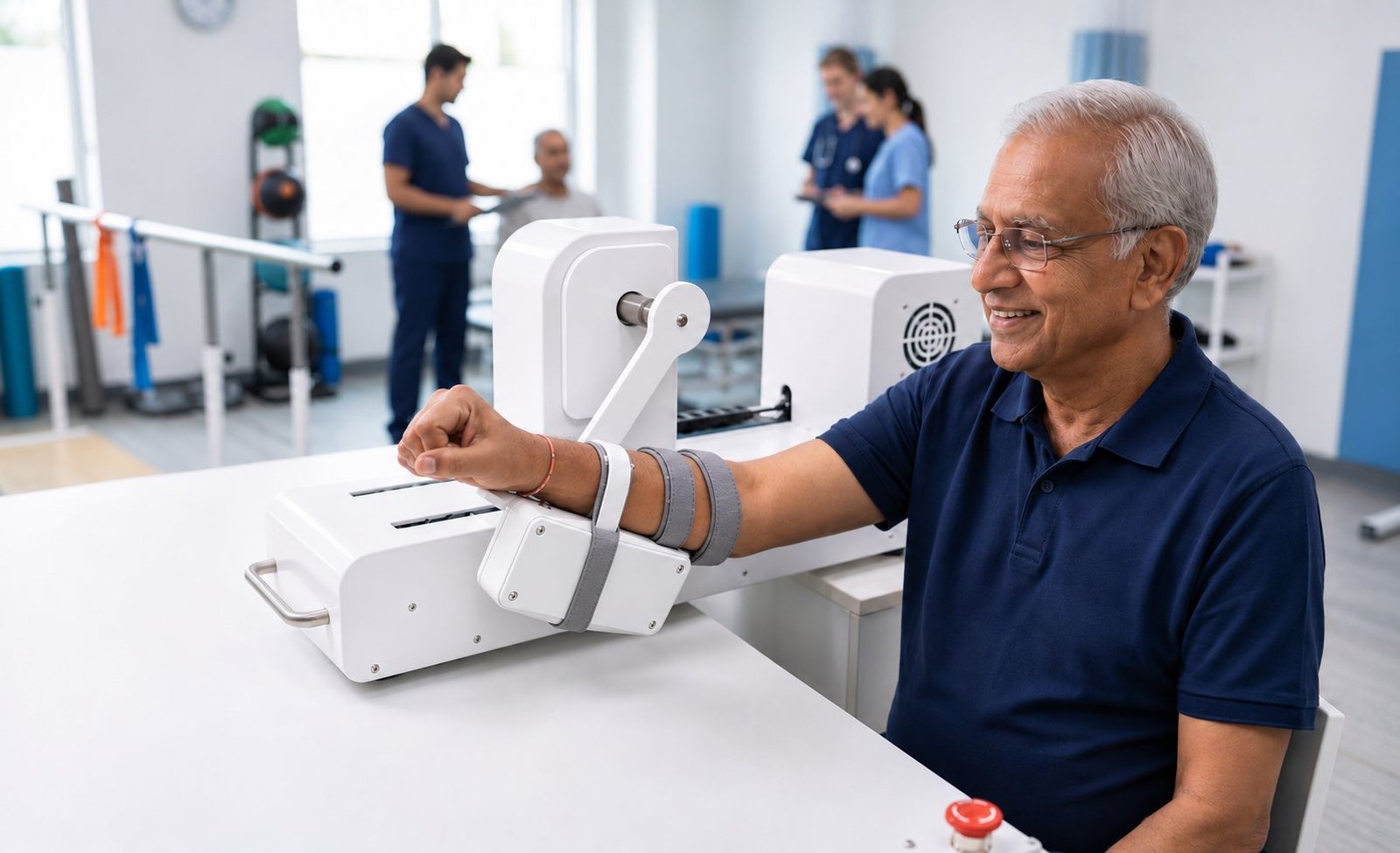
A Cochrane review of 45 trials and 1,619 people after stroke found robot-assisted arm training improved activities of daily living (SMD 0.31), arm function (SMD 0.32) and arm muscle strength (SMD 0.46), rated high-quality evidence. Adverse events were rare and drop-out did not increase.
Mehrholz et al., Cochrane 2018 5
45 → 62
More people walking independently
Out of every 100 people unable to walk after stroke, about 62 walked independently after electromechanical gait training plus physiotherapy, versus 45 with physiotherapy alone (OR 2.01, 38 trials, 1,567 people). The 2025 update again found higher odds of independent walking (OR 1.65).
Mehrholz et al., Cochrane 2020 and 2025 6
+7.6 pts
Gains even years after a stroke
In 127 veterans at least six months after stroke, robot-assisted therapy improved Stroke Impact Scale scores by 7.64 points over usual care at 12 weeks, and Fugl-Meyer arm scores by 2.88 points at 36 weeks, without raising total healthcare costs.
Lo et al., NEJM 2010 3
26 → 37
High dose works in chronic stroke
In the Queen Square programme, 224 patients a median of 18 months after stroke received 90 hours of upper-limb therapy over three weeks. Median Fugl-Meyer arm scores rose from 26 to 37 and Action Research Arm Test scores from 18 to 27 by six months, and gains kept growing after discharge.
Ward et al., JNNP 2019 7
10× dose
Hundreds of repetitions are achievable
A one-hour outpatient programme reached an average of 322 task repetitions per session in people with chronic stroke, ten times the usual 32, with low pain and fatigue ratings.
Birkenmeier et al., 2010 4
+9.3 cm
Parkinson's disease: longer, steadier steps
A meta-analysis of seven randomised trials found robot-assisted gait training improved stride length by 9.3 cm and Berg Balance Scale scores by 3.9 points in people with Parkinson's disease, with balance gains still present at one month.
Alwardat et al., 2018 8