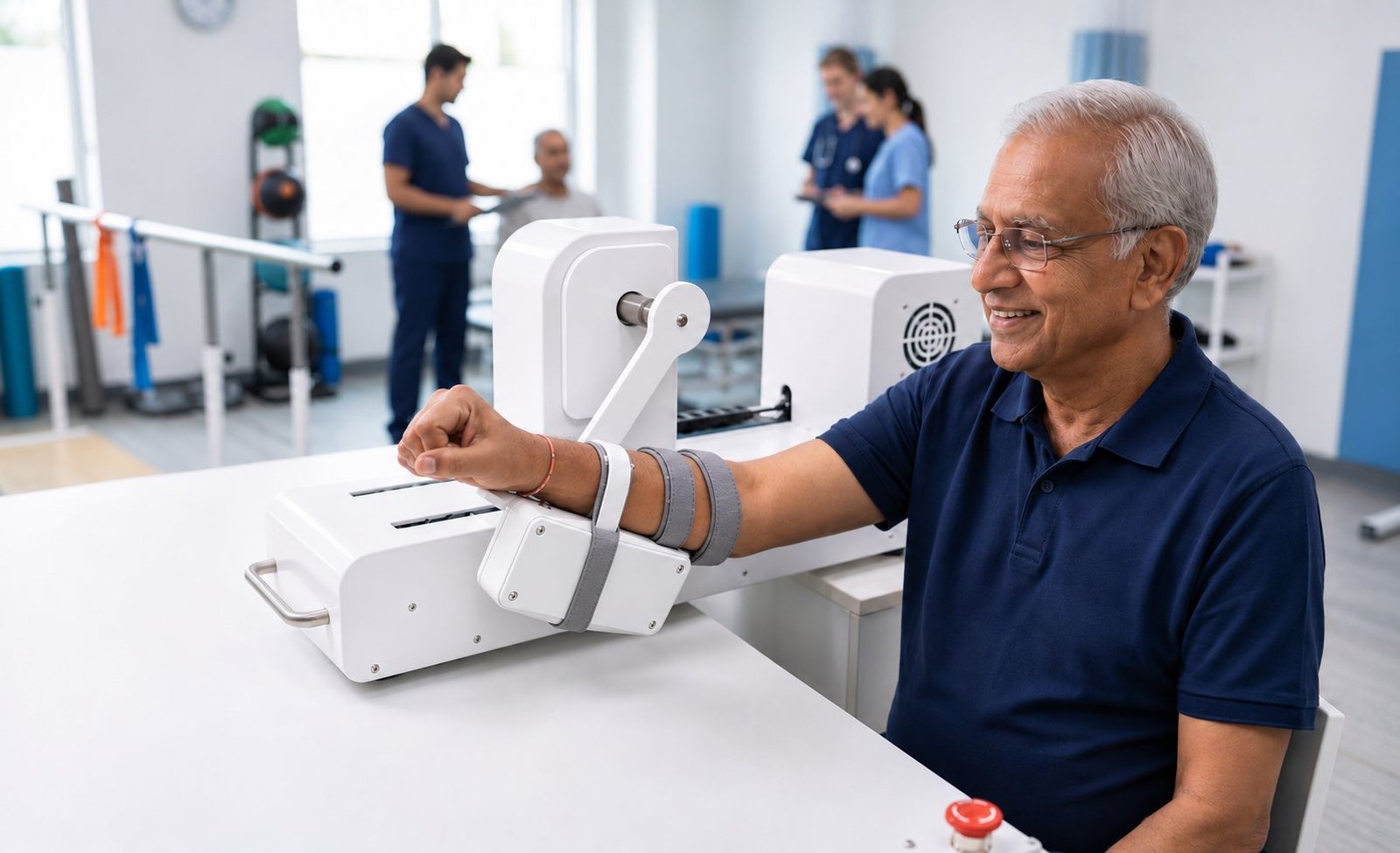
Physiotherapy

Multiply what every therapist can deliver.

Clinics, rehab centres and elder-care homes run on therapist hours. Robotic assistance takes over the repetition, so each therapist can guide more patients, each patient gets a higher dose, and progress becomes something you can measure and show.

Physiotherapy clinic using Therabot
2.4billion

people live with conditions that would benefit from rehabilitation. In many low- and middle-income countries, more than half never receive it.

Cieza et al., 2020; WHO 1,2
0.36

practising physiotherapists per 10,000 people in India, compared with 16.85 in Australia.

World Physiotherapy 3
70%

Non-adherence to home exercise programmes can be as high as 70%.

Bachmann et al., 2018 4
The capacity problem

Demand grows every year. Therapist hours do not.

Every patient needs a high dose of practice, but a therapist can only guide one limb at a time. Observed stroke sessions average just 32 arm repetitions, a fraction of what motor learning requires. 5

Then the patient goes home, where the work is meant to continue and too often does not. Robotic rehabilitation changes the equation: the robot carries the repetition, the therapist carries the clinical judgement, and the same team can serve more people, better.

The evidence

More dose, same team, measurable results.

€4.15 vs €10

One therapist, several patients

In a randomised trial of robot-assisted group arm therapy after stroke, patients trained in a robot group supervised by one therapist improved as much as those in one-to-one therapy, while a session cost €4.15 per patient instead of €10.00.

Hesse et al., Clinical Rehabilitation 2014 6
1,024 moves

High intensity, without higher total cost

Robot-assisted therapy delivered 1,024 arm movements per one-hour session in the VA ROBOTICS trial. Over 36 weeks, total healthcare cost per patient was similar to intensive therapist-led care ($15,562 vs $15,605).

Lo et al., NEJM 2010; MIT News 7
98.3%

Home therapy that works and that patients keep doing

In a 124-patient randomised trial, home-based telerehabilitation was not inferior to the same therapy in clinic (Fugl-Meyer gains of 7.86 vs 8.36 points). Patients at home completed 98.3% of their sessions, versus 93.3% in clinic.

Cramer et al., JAMA Neurology 2019 8
10 trials

Games add therapy time, and function follows

A Cochrane review found that when virtual reality and interactive games were added to usual care to increase therapy time, upper-limb function improved (SMD 0.49, 10 trials), along with activities of daily living (SMD 0.25).

Laver et al., Cochrane 2017 9
For your clinic

Built for the way clinics actually work.

No dedicated room, no six-figure budget. Therabot sits on the tables you already have, at about one-tenth the cost of conventional rehabilitation robots.

Run stations in parallel

Several Therabot units, one therapist. Each patient gets a full, high-repetition session.

Arm, leg and gait from one investment

Tabletop for the arm, floor-top for the leg, two units for gait. One platform covers most of your caseload.

Progress you can show

Sessions and repetitions are recorded, so patients, families and referring doctors can see improvement.

Keep patients between visits

Alvio VR's wearable sensor games and home Therabot units keep therapy going at home, with your clinic still in the loop.

Elder-care homes

A portable robot under 20 kg moves between rooms, bringing regular, guided movement to residents who cannot travel.

References

The studies above evaluated robotic, home-based and game-based rehabilitation in general, using a range of devices and protocols. They are not studies of Anthera products, which are currently sold as assistive devices, not medical devices, while our own clinical trials are under way.

  1. Cieza A, et al. Global estimates of the need for rehabilitation based on the Global Burden of Disease study 2019. Lancet. 2020;396(10267):2006–2017. doi:10.1016/S0140-6736(20)32340-0
  2. World Health Organization. Rehabilitation in the context of WHO's mandate. who.int
  3. World Physiotherapy. Member organisation profile: India (practising physiotherapists per 10,000 population). world.physio/membership/india
  4. Bachmann C, et al. Recommendations for improving adherence to home-based exercise: a systematic review. Phys Med Rehab Kuror. 2018;28:20–31 (citing Jack et al., 2010). doi:10.1055/s-0043-120527
  5. Lang CE, et al. Observation of amounts of movement practice provided during stroke rehabilitation. Arch Phys Med Rehabil. 2009;90(10):1692–1698. doi:10.1016/j.apmr.2009.04.005
  6. Hesse S, et al. Effect on arm function and cost of robot-assisted group therapy in subacute patients with stroke and a moderately to severely affected arm: a randomized controlled trial. Clin Rehabil. 2014;28(7):637–647. PEDro record
  7. Lo AC, et al. Robot-assisted therapy for long-term upper-limb impairment after stroke. N Engl J Med. 2010;362(19):1772–1783. PMC5592692; cost figures reported by MIT News
  8. Cramer SC, et al. Efficacy of home-based telerehabilitation vs in-clinic therapy for adults after stroke: a randomized clinical trial. JAMA Neurol. 2019;76(9):1079–1087. doi:10.1001/jamaneurol.2019.1604
  9. Laver KE, et al. Virtual reality for stroke rehabilitation. Cochrane Database Syst Rev. 2017;11:CD008349. doi:10.1002/14651858.CD008349.pub4