Orthopedics

Get patients moving sooner, and further.

After joint replacement, fracture or trauma, the first weeks shape the long-term result. Early, frequent and guided movement shortens hospital stays and rebuilds strength. Robotics make that frequency practical on every ward and at home.

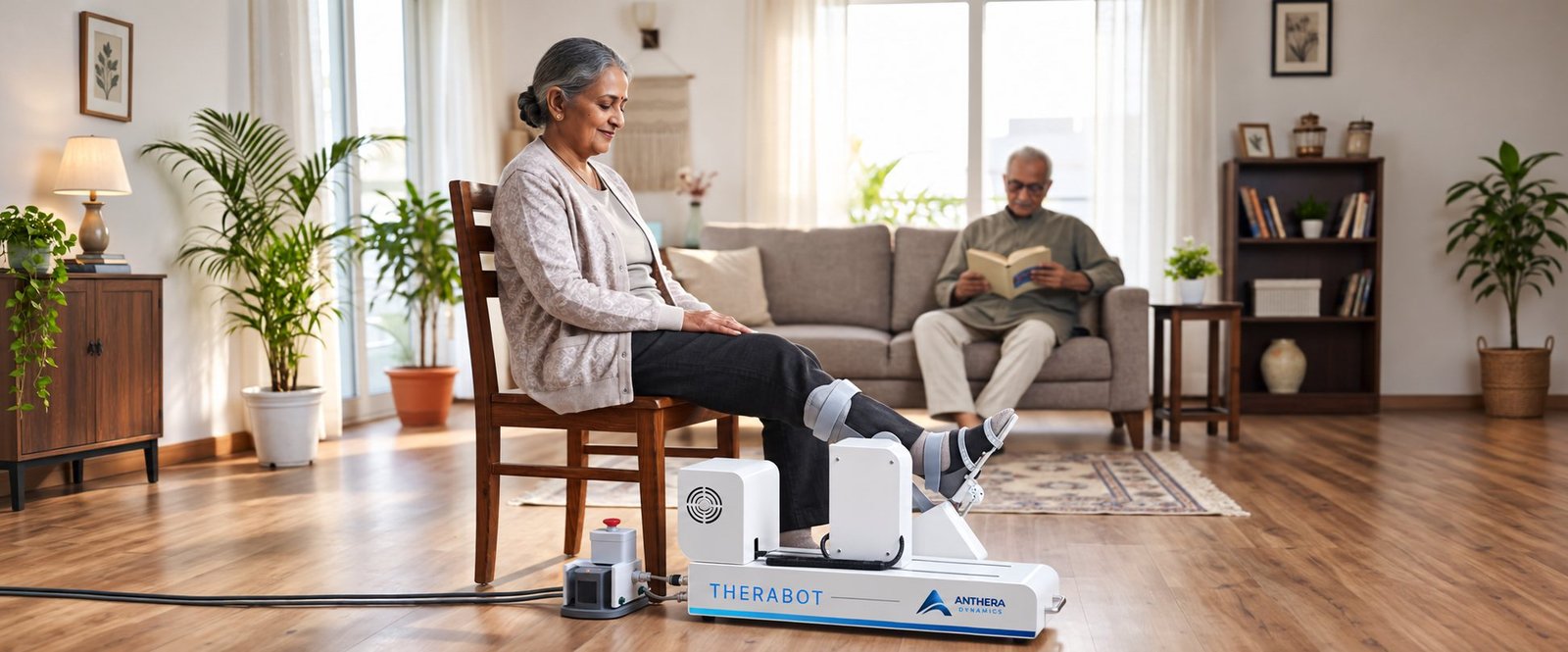
Patient doing knee and hip rehabilitation on Therabot
1.71billion

people worldwide live with musculoskeletal conditions that would benefit from rehabilitation.

Cieza et al., The Lancet 2020 1
60%

of quadriceps strength can be lost in the first month after knee replacement, even with rehab started straight away.

Bade et al., 2017 2
1.8days

shorter hospital stay when patients are mobilised early after hip or knee replacement.

Guerra et al., 2015 3
The first month

Surgery fixes the joint. Rehabilitation restores the person.

More than 700,000 knee replacements are performed each year in the United States alone, with 3.5 million a year projected by 2030. Yet quadriceps strength can fall by 60% in the month after surgery, and recovering to the level of healthy adults is rare. 2

Every extra day of bed rest costs muscle, confidence and money. The answer the evidence points to is simple: movement that starts early, happens often and is guided well. That is exactly the kind of repetitive, measurable work a robot does best.

The evidence

Early, guided movement pays off.

−1.8 days

Shorter stays after hip and knee replacement

A meta-analysis of five randomised trials (622 patients) found early mobilisation after hip or knee replacement reduced length of stay by 1.8 days (95% CI 1.1 to 2.6), with patients first walking on day 2.2 instead of day 3.6 and no increase in adverse outcomes.

Guerra et al., Clinical Rehabilitation 2015 3
40 trials

Better mobility after hip fracture

A Cochrane review of 40 trials and 4,059 people found that gait, balance and functional training in hospital probably produces a moderate improvement in mobility (SMD 0.57), and that mobility programmes after discharge give a small, clinically meaningful gain (SMD 0.32, high-certainty evidence).

Fairhall et al., Cochrane 2022 4
89% vs 35%

Robot-assisted knee training after replacement

In an early post-operative study of robot-assisted knee exercise after total knee arthroplasty, extension lag improved by 89.4% with robotic assistance versus 34.8% with conventional exercise, and pain scores improved by 40.7% versus 20.4%.

Assistive Technology, 2016 5
12 months

Earlier robotic rehab, better quality of life

In a randomised trial of 68 knee replacement patients, those who started robot-assisted knee exercise within four hours of surgery recovered knee extension and range of motion more quickly and reported better quality of life at 12 months.

Watabe et al., J Rehabil Med 2026 6
For your orthopedic pathway

From post-op day one to full strength.

Therabot delivers the hip, knee and shoulder movements your protocols call for, with every session counted, at about one-tenth the cost of conventional rehab robots.

On the ward, from day one

Therabot Pro at the bedside for assisted hip and knee movement while the patient is still in bed.

Inpatient physiotherapy

Floor-top Therabot for hip and knee flexion and extension and hip abduction and adduction, with repeatable, recorded sessions.

Shoulder and upper limb

Tabletop Therabot for shoulder flexion, abduction and elbow work after fracture or shoulder surgery; Dextro (coming soon) for the hand and wrist.

After discharge

Under 20 kg, Therabot can continue therapy at home, and Alvio VR's games help patients keep up their programme.

References

The studies above evaluated early mobilisation and robotic rehabilitation in general, using a range of devices and protocols. They are not studies of Anthera products, which are currently sold as assistive devices, not medical devices, while our own clinical trials are under way.

  1. Cieza A, et al. Global estimates of the need for rehabilitation based on the Global Burden of Disease study 2019. Lancet. 2020;396(10267):2006–2017. doi:10.1016/S0140-6736(20)32340-0
  2. Bade M, et al. Performance on a clinical quadriceps activation battery is related to a laboratory measure of activation and recovery after total knee arthroplasty. Arch Phys Med Rehabil. 2018;99(1):99–106 (background figures). PMC5748250; see also Bade MJ, et al. Arthritis Care Res. 2017;69(9):1360–1368, PMC5415445
  3. Guerra ML, Singh PJ, Taylor NF. Early mobilization of patients who have had a hip or knee joint replacement reduces length of stay in hospital: a systematic review. Clin Rehabil. 2015;29(9):844–854. doi:10.1177/0269215514558641
  4. Fairhall NJ, et al. Interventions for improving mobility after hip fracture surgery in adults. Cochrane Database Syst Rev. 2022;9:CD001704. doi:10.1002/14651858.CD001704.pub5
  5. Robot-assisted rehabilitation with the single-joint Hybrid Assistive Limb in the early post-operative period after total knee arthroplasty. Assistive Technology. 2016. doi:10.1080/10400435.2016.1219883
  6. Watabe T, et al. Effect of early hybrid assistive limb assisted rehabilitation on functional outcomes and patient satisfaction after total knee arthroplasty: a randomized controlled trial. J Rehabil Med. 2026;58:jrm43925. doi:10.2340/jrm.v58.43925